“How do I stop social media from taking over my workday?” A system for focusing first, social second
I need to stop social media from taking over my workday any further! I just wasted 45 minutes trying to add a project to LinkedIn, did it incorrectly, then had to start over. My dog is upset that I’m off schedule for his walk and keeping him waiting. I haven’t even gotten into my emails for the day, nor any of my project-work, and it’s almost 2pm. I literally spent the entire morning – much more than 45 minutes – getting nothing forward-moving done.
How did this happen when I swore off social media and much of the web for the last 4 years, outside of work use and info searches? I have a better system for this.
As an exercise in how to approach practicing skills and new systems, I will be sharing how I should have organized my morning to have a better outcome with my time management.
“Focus first, socials second” philosophy for productivity
Focusing first, social second is the general theme of my system for managing my social media time, which is very much needed for my work too. But the specifics and ability to turn the system into a habit is what will lead to success, and I am practicing this skill in real time.
A little backstory for you, and maybe even a status update for those who know me and have noticed this absence: I gave up all social media for over four years, and I really enjoyed it. But alas, something has been (admittedly) missing in my ability to connect with everyone I know easily. This year, I returned to my former channels, as well as new ones and have a whole new perspective.
My Social Media Dark Ages: A conscious decoupling from the net
Like many overwhelmed Americans and global citizens in 2022, I was burned out on news, tracking pandemic updates, and the general flood of information reaching me anytime I was online. As a compulsively private / somewhat shy person, I was never a very active with social media anyways, but I was functional. I kept up.
In early 2022, though, I stopped it all after a downward cycle that first emerged around Covid times. No more social checks, no more morning news podcast, no more Apple News. One by one, they disappeared from my routine.
Though it wasn’t deliberate at first to cease following current events and socials, I noticed one day that I had an absence streak going. I simply didn’t care to break it. Like Forest Gump, I kept running with my no-net streak.
With my disengagement firmly established, I focused more on…well, anything else. Life, work, love – they all can take up a bit of time too.
As an added dimension, I was going through a heavy personal time, so I was not feeling very social media “social” either. That event was definitely the catalyst for my social media dark age, but I can’t attribute all the quiet-time to it. It was just the spark that ignited an experiment with myself to completely cut off that part of the “noise” – just for awhile – without the undercurrent of social media in my mental periphery.
Rest assured, this was all done under the care of a wonderful coach and therapist.
Restarting my socials after a hiatus: a new productivity challenge
Flash forward to now. Having social media and the news cycle out of my mental space for a years-long break did wonders for my healing process, as well as my productivity. Surprisingly, though, the (gentle) return to the socials and news cycle has been quite refreshing too.
But a familiar issue has been re-introduced: the war between social media channels’ inherent algorithm to suck you in, versus everything else you need to produce in your working time. In other words – “how do I stop social media from taking over my workday?”
Even greater – “how do I keep social media in balance when I need to be on channels like LinkedIn, Reddit, and Facebook for work?”
How to build a focus-first workday routine (social second)
Being a business coach who specializes in workflow and efficiency, I am irritated with my loss of productivity this morning, because I know better! The exact system I preach for building a focus-first routine for work is the exact system I did not use today. I missed an opportunity to maximize my time.
However, this also proves that everyone needs practice to create new habits, and I am no exception. In the nearly two-decades that I was a Piano teacher, there were pieces I needed to practice ahead of my students in order to effectively teach the material too.
Business development skills are grown in the same way for both the teacher and student. So as you dive in to changing your workflow, know that it will take time and honest self-analysis to really evolve in the way you approach a process, and that is normal – even for the teacher! Teachers have to practice too.
Set boundaries with social media when you work from home or in the office
As a first step, we need some rules to build a focus-first routine! When you have clear boundaries around your social media usage time – yes, just like a teenager – you are more likely to comply. Why? Because you have something established as right and wrong to guide you. Without clear boundaries around when you can engage with social media and how, it is too difficult to make that call to move on to work in the moment.
Remember – the sites are designed this way to draw you in, so we have to be aware as workers. Even if you do not master following your boundary at first (like me today), you will improve your habits if you practice with determination.
5 rules to limit social media distractions while working remote, or in office:
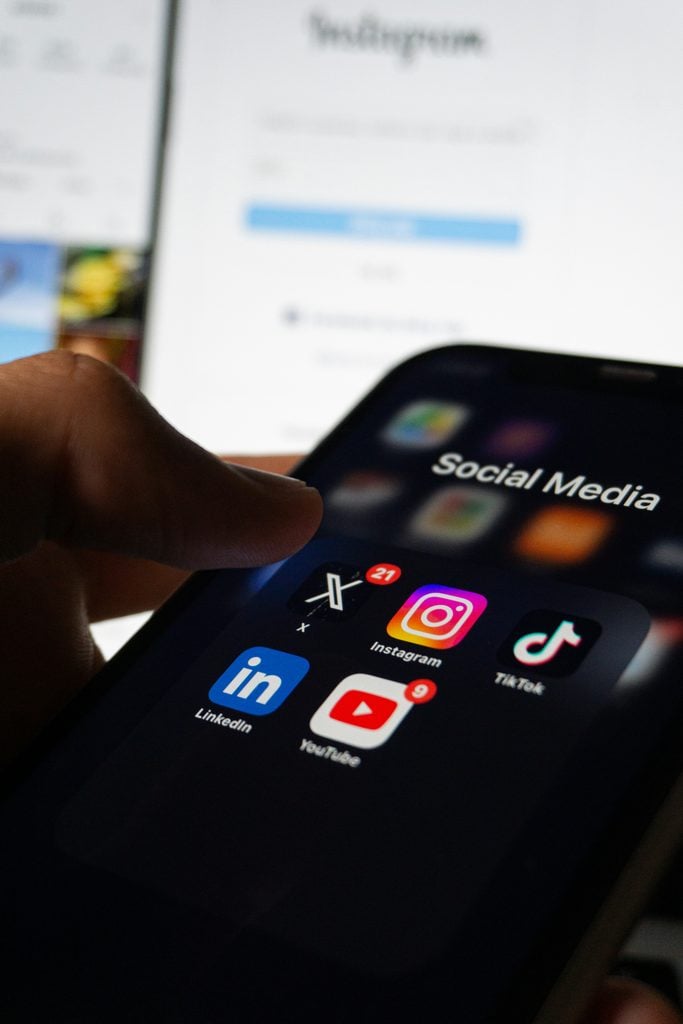
- Do NOT go straight to a social media site, or app when opening my computer, phone, or tablet during work hours. I avoid these channels until a designated time, and they are never first. Instead, focus-work comes first, like larger projects, or even emails (which need productivity rules too).
- Close out social media apps on my devices when turning them off. This practice keeps me from opening my phone, computer, or tablet and immediately landing on one of these channels. I don’t want Insta to be the first thing I see when I open my phone, for example, so I make sure to close the app out when I am done.
- Approach social media work that is part of my job with a purpose – always have an initiative. “I am going to check notifications”, “I am going to share an article”, “I want to find (x) organization’s pages”… etc. This prevents doom-scrolling and looking for cues vs. going in with a plan if social media is for work.
- Time social media usage for work and limit it to 60 mins, or less, depending on the work I’m doing on a specific channel.
- Add social media objectives and specific tasks / posts for the week to work deliverables. These items appear the same way reports, blogs, and other items do in my “work to complete” schedule. This organization system has changed my approach and mentality with social media for work.
These rules work for me, because they are not about micro-managing my time on social channels. They promote achieving goals and specific tasks while removing distractions.
The key is creating the best environmental factors for success, rather than focusing on the smaller process-details that are created by starting in the wrong direction.
Does working from home increase your distraction from social media more than working from an office?
My opinion is that the setting you are in for work does NOT contribute to your social media distraction risk. Really, I don’t.
Most of us have some way to access the apps with us at all times, so being at home, or in the office is the same thing. Pull out your phone at your work desk, or log in to Facebook from the office. Boom…same challenge the work from home individual is faced with.
Instead, I like to sort a professional’s risk of social media distraction by the industry they are in, not the setting. Easy access to social media at your job combined with the need to use social media for your work will separately, and jointly, increase your risk of distraction from these channels.
For example, if you work in marketing and managing social media campaigns is part of your job, you must engage with the social platforms in order to work. You have the most danger of all for getting sucked into the feeds and losing time to doom-scrolling. You are highest on the spectrum risk, because of the amount of need and access you have to socials.
But on the opposite end, if you work in a highly secure environment, or productivity-driven occupation that focuses on direct output quantity, the risk becomes lower that you can engage with social media while on the job. There is a natural separation of life outside of the workspace (even at home) in these fields while “on the clock”.
At the end of the day, the key is exposure and access. When these are more limited – by you, or the forces-that-be in your work environment – the amount of distraction that can even take place is naturally capped.
My personal belief is that the best systems for workflow and learning are those that make building new skills and habits natural. For teams that need social media, but can’t sacrifice too many working hours to it, strategic engagement rules for how different channels are used and removing temptations to over-stay in that online space make a world of difference.
How to take back your focus time and reduce social media distractions – in conclusion
Cutting temptations to over-engage with social media during working hours combined with planning are strategies that have helped me manage my newfound immersion in social media.
Coming from a total shut-down period with all the different socials, then jumping fully back in to these familiar, but evolved, channels has given me a new perspective on how to manage my time and attention online.
In my time away, I learned how to enjoy silence again, sharpen my focus, and engage with others the way my grandmother would (if she knew how to text and email). But I missed the world that is online. It’s endlessly special that we have so many resources, people, and ways to connect all around us, from anywhere.
That potential and the daily repercussion when you are getting your coffee and turning on your computer can be overwhelming for us humans. Just as I am learning – be patient with yourself, but disciplined in your social media habits. Don’t let the ability to connect run your working hours.
If you are in need of productivity strategies for yourself, or your team, learn more about how AstroCat can help with custom training solutions and workflow systems. Contact us for details on our business coaching for professionals and leaders, or solutions recommendations for your business.